🌌 Humanity’s Greatest Wonder: The Space Station Orbiting 400 Kilometers Above Earth
Discover how the International Space Station — orbiting 400 kilometers above Earth — became humanity’s greatest technological and scientific wonder. Learn its story of creation, unity, and innovation that inspires the next generation of explorers. ABC News
Humanity’s Dream Among the Stars
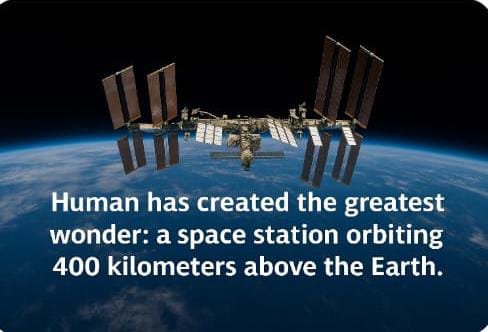
When humanity first looked at the stars, space seemed unreachable — a place of mystery and dreams. Today, 400 kilometers above the Earth, a magnificent human creation floats silently through the darkness: the International Space Station (ISS).
This orbiting laboratory circles our planet every 90 minutes, traveling at a breathtaking speed of 28,000 kilometers per hour. It is not only a feat of engineering but also a symbol of unity and perseverance — a wonder born from the imagination and determination of humankind.
The Birth of a Celestial Marvel
The idea of a “space home” was once confined to the pages of science fiction. But on November 20, 1998, that dream took its first real form with the launch of the Russian module Zarya. Since then, nations have come together to build this colossal structure, now larger than a football field and weighing over 420,000 kilograms.
The ISS is the result of cooperation between 15 nations — including the United States, Russia, Japan, Canada, and members of the European Space Agency. Together, they created a floating city where scientists and astronauts live, work, and conduct experiments that reshape our understanding of life and the universe.
A Home in the Sky
Life aboard the ISS is like living in a world beyond gravity. Astronauts drift gently through its modules, performing experiments in microgravity on medicine, biology, physics, and Earth observation. These discoveries are helping to improve healthcare, technology, and sustainability on Earth.
Each day on the ISS brings 16 sunrises and 16 sunsets. Astronauts eat specially designed meals, sleep in small pods to prevent floating, and exercise for hours to stay healthy. Despite the challenges, they describe the view of Earth — glowing blue and fragile — as life-changing. From space, borders disappear, and humanity appears as one family sharing one home.
Unity Beyond Borders
In an era often marked by political tension, the International Space Station stands as a shining example of global unity. It shows how nations can work together for the benefit of all humankind. Russian rockets have launched American astronauts; Japanese and European scientists collaborate seamlessly; and each mission strengthens bonds of peace through science.
From its orbit, the ISS reminds us that Earth has no boundaries visible from space. It urges us to look beyond divisions and focus on collective progress. Humanity’s survival and advancement depend on the same cooperation that built this orbiting wonder.
Engineering Excellence and Innovation
Operating a laboratory in space requires unparalleled engineering genius. Every system on the ISS — from air purification to waste recycling — must function flawlessly in a zero-gravity environment. The station’s massive solar arrays capture sunlight to generate power, while advanced systems recycle water from air and even perspiration.
Traveling 400 kilometers above our planet, the ISS completes one orbit every 90 minutes — a rhythm of sunrise and sunset that continues endlessly. This technological marvel demonstrates that human ingenuity knows no limits.
Inspiring Future Generations
The ISS has become a classroom for the world. Students from across continents connect with astronauts via live calls, conduct virtual experiments, and dream of becoming the next space explorers. The data gathered on the station has laid the foundation for future missions to the Moon, Mars, and beyond.
India’s upcoming Gaganyaan Mission, NASA’s Artemis Program, and private ventures like SpaceX and Blue Origin all build upon the knowledge gained aboard the ISS. It is not just a laboratory — it’s the launchpad for humanity’s future among the stars.
Legacy of the Greatest Wonder
When we say, “Human has created the greatest wonder — a space station orbiting 400 kilometers above Earth,” we acknowledge a milestone that defines our era. The ISS represents the best of what humanity can be — innovative, united, and visionary.
Even after its eventual retirement, its legacy will continue to inspire generations. It will be remembered not only as a space laboratory but as a monument to human spirit and cooperation — proof that imagination and courage can overcome gravity itself.
🌍 A Message from Hindvaacha
At Hindvaacha.com, we believe in celebrating stories that ignite pride in human progress. The International Space Station is more than a technological achievement; it is a symbol of hope, peace, and limitless potential.
Four hundred kilometers above, a silent marvel continues its eternal dance around our world — whispering one powerful truth:
2 Comments