Introduction
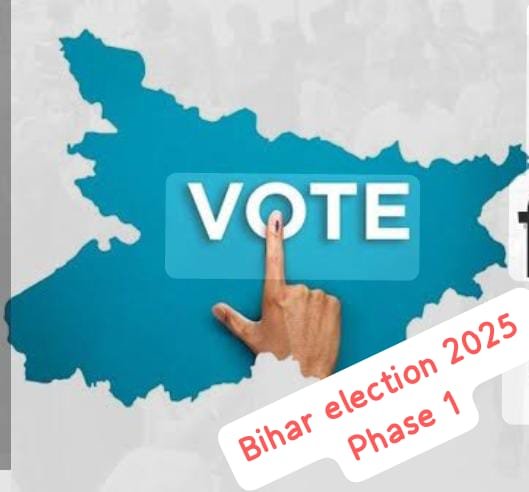
The political temperature in Bihar soared today as the state witnessed the first phase of its 2025 Assembly Elections, a crucial democratic exercise that could redefine the political landscape not just for the state but also for India’s national politics. Voting began at 7 a.m. across 121 constituencies amid tight security and enthusiastic participation from voters. This election marks a direct face-off between the ruling National Democratic Alliance (NDA), led by Chief Minister Nitish Kumar and the Bharatiya Janata Party (BJP), and the Mahagathbandhan (Grand Alliance) spearheaded by Tejashwi Yadav’s Rashtriya Janata Dal (RJD) along with the Congress and Left parties.
The Election Commission has announced that the second phase of polling for the remaining 122 constituencies will take place on November 11, while the results will be declared on November 14, 2025.
Smooth Polling and Voter Enthusiasm
Despite early morning chill and scattered reports of minor technical glitches in EVM machines, the voting process across Bihar remained largely peaceful. According to the Election Commission of India, the state recorded nearly 64.6% voter turnout, one of the highest in Bihar’s electoral history. The commission also highlighted the remarkable participation of women and first-time voters, describing it as a “festival of democracy.”
Polling stations across districts like Patna, Gaya, Nawada, Bhagalpur, and Muzaffarpur saw long queues from early morning hours. Many voters were seen clicking selfies after casting their votes, displaying their inked fingers with pride. In rural areas, women turned out in large numbers, underlining their growing influence in Bihar’s political process.
Security arrangements were tight, with central paramilitary forces and local police deployed in sensitive constituencies. Drones were used for aerial monitoring, and CCTV cameras ensured transparent polling in all major centers. NDTV
Key Contests and Star Candidates
This election is witnessing several high-profile contests. In Patna Sahib, BJP’s Samrat Choudhary, the state’s Deputy Chief Minister, faces a tough challenge from RJD’s Anshul Yadav. Similarly, in Raghopur, RJD leader Tejashwi Yadav is contesting to retain his stronghold, while the NDA has fielded Satish Kumar from the JD(U).
Chief Minister Nitish Kumar, though not contesting directly, has his political credibility at stake as the leader of the ruling alliance. The election will be seen as a referendum on his governance model, often hailed for improved infrastructure and law and order, but criticized for rising unemployment and migration.
Another talking point in this election is the debut of Prashant Kishor’s Jan Suraaj Party, which is contesting across several constituencies. Kishor, a former political strategist, aims to offer an alternative to both NDA and RJD-Congress politics. While analysts predict a limited impact, his movement has attracted significant youth and intellectual backing in urban areas.
Major Issues Dominating the Polls
The Bihar Election 2025 has revolved around several core issues that directly affect everyday life in the state.
- Employment and Migration:
Unemployment remains one of the most pressing concerns. Lakhs of Bihar’s youth migrate to metro cities every year seeking jobs. The opposition has capitalized on this, promising large-scale employment drives and skill development programs. - Law and Order:
While Nitish Kumar’s government claims to have restored peace and safety in Bihar, opposition leaders allege that crime rates, especially against women, have risen in the past year. - Education and Health:
Poor infrastructure in schools, teacher shortages, and underperforming government hospitals have become major talking points during campaign rallies. - Caste and Social Justice:
Bihar’s politics has historically been shaped by caste dynamics. While RJD continues to champion the cause of social justice and empowerment of marginalized communities, the NDA promotes development and inclusivity beyond caste boundaries. - Development and Infrastructure:
Roads, electricity, and housing schemes remain central to the NDA’s narrative. Prime Minister Narendra Modi, in his campaign speeches, emphasized “Viksit Bihar” (Developed Bihar) as a continuation of his national “Viksit Bharat” vision.
Campaign Highlights
The election campaign saw fiery exchanges between top leaders. Prime Minister Narendra Modi and Home Minister Amit Shah addressed several rallies urging voters to choose “stability and development,” while Tejashwi Yadav promised “naukri aur nyay” (jobs and justice). Nitish Kumar’s emotional appeal for one final term as CM drew mixed reactions, with the opposition accusing him of political fatigue.
Congress leader Rahul Gandhi and Left leaders also joined the campaign trail, accusing the BJP-JDU alliance of neglecting education and healthcare sectors. The Jan Suraaj campaign, meanwhile, focused on local governance and transparency.
What’s at Stake
The 2025 Bihar Assembly election is not just about choosing the next government of Bihar—it’s about determining the direction of national politics ahead of the 2029 Lok Sabha elections. With 243 assembly seats and 40 Lok Sabha constituencies, Bihar’s political outcome can influence alliances, national narratives, and leadership equations.
A strong NDA performance will reaffirm Nitish Kumar’s relevance in state politics and consolidate BJP’s grip ahead of future elections. On the other hand, if Tejashwi Yadav’s Mahagathbandhan gains momentum, it could signal a generational shift in Bihar’s leadership, bringing back the RJD’s dominance after a decade-long gap.
Conclusion
As the first phase of polling concludes, the Bihar Election 2025 has already made one thing clear — democracy in the state remains vibrant and deeply rooted among its citizens. From first-time voters to elderly participants, people turned out in record numbers to shape their future.
The battle lines are clearly drawn. Development versus social justice, governance versus change — Bihar stands at a crossroads once again. The final outcome on November 14 will not only decide who rules the state for the next five years but will also set the tone for India’s evolving political story.
BLOs Begin SIR Form Distribution: Ensuring Accurate Voter Lists for India’s Democracy
2 Comments