

Decisive Surge: The Unstoppable NDA Victory in the Bihar 2025 Elections
The National Democratic Alliance (NDA) — spearheaded by the Bharatiya Janata Party (BJP) and its local ally Janata Dal (United) (JD(U)) — achieved a resounding victory, while the principal opposition alliance, the Mahagathbandhan (MGB), suffered a dramatic setback.
Massive Mandate for the Ruling Alliance
The NDA’s dominance is unmistakable. Early trends from vote-counting show the alliance comfortably crossing the 200-seat mark out of the state’s 243 assembly constituencies. Moneycontrol+2The Economic Times+2 Within the coalition, the BJP and JD(U) led the charge with strong showings, along with key support from smaller allies such as the Lok Janshakti Party (Ram Vilas) (LJP-RV). The Indian Express+1 In contrast, the Mahagathbandhan’s performance was anaemic — its core parties fell well short of expectation. www.ndtv.com+1
Historic Voter Turnout and the New Math of the Mandate
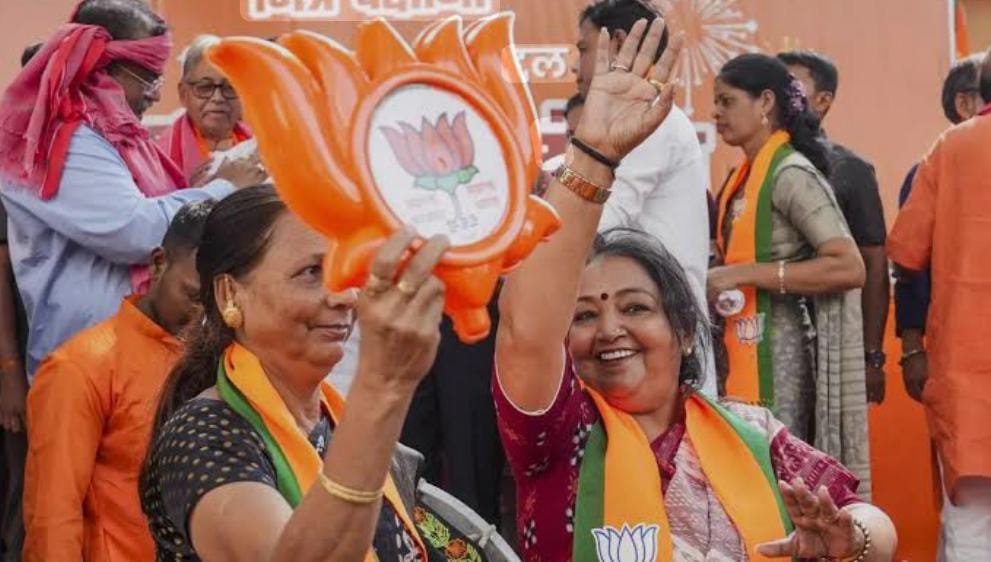
One striking hallmark of this election was the high voter turnout. Preliminary numbers indicate around 66.9% of registered voters cast ballots, the highest participation in Bihar’s recent history. The Economic Times A confluence of factors appears to have shaped this outcome: a broad caste coalition deployed by the NDA, enhanced female and youth participation, and a campaign focused on “development” narratives over traditional identity politics. Analysts note that the old “M-Y” (Muslim-Yadav) arithmetic was replaced in this election by a newer “MY” — that is, Mahila (women), Youth & EBCs (Extremely Backward Classes). India Today+1
Why the NDA Won — and the Opposition Failed
Several key dynamics underpin the outcome:
- Broader social coalition: The NDA succeeded in forging a wide alliance of EBCs, Dalits, Other Backward Classes (OBCs) outside the Yadav core, women and aspirational youth — capturing a roughly 49% vote share compared with around 38% for the opposition. India Today+1
- Effective campaign messaging: The coalition’s messaging emphasised governance, infrastructure, jobs and women’s welfare rather than solely relying on caste loyalties, helping it appeal beyond traditional vote banks. Reuters
- Opposition’s strategic mis-fire: The Mahagathbandhan, despite consolidating its core Muslim-Yadav constituency, failed to broaden its appeal. Its organisational machinery collapsed under the NDA onslaught, and it lost key seats and momentum. The Times of India
- Women and youth turn-out: Female voter turnout surged and appears to have tilted the balance. Politicians and analysts alike credited women’s votes as a decisive factor in the verdict. Reuters
Key Leaders and Political Implications
For the BJP, led nationally by Narendra Modi, this election is a significant rebound after its national setbacks in 2024. The Bihar win strengthens their foothold amidst the Hindi-heartland states. Financial Times The JD(U), under Nitish Kumar, has re-established its importance in Bihar politics, consolidating its position as a kingmaker in the state. On the opposition side, the defeat dealt a heavy blow to Tejashwi Yadav and the RJD (Rashtriya Janata Dal), both of whom struggled to convert momentum into seats. The Indian Express
Nationally, the verdict sends a signal far beyond Bihar. The state is politically significant because of its population size, number of parliamentary seats, and its role as a barometer of government performance in India’s eastern belt. Analysts suggest that success in Bihar fuels momentum for the ruling coalition across other large states. Financial Times+1
What Lies Ahead — Challenges and Responsibilities
With victory secured, the ruling alliance now faces heightened expectations. Delivering on promises of development, job creation, law-and-order, and social inclusion will be critical. Failure to translate the mandate into tangible benefits may erode the goodwill generated. For the opposition, this defeat necessitates urgent introspection: organisational renewal, broadening appeal beyond traditional vote banks, and rebuilding credibility.
The result also raises questions about opposition strategy in India — how to compete when the dominant coalition crafts a wider social base and tracks beyond identity politics. For the country’s democratic institutions and polity, the high voter turnout is reassuring, but the margin of victory throws into sharp relief the disparities in organisational strength and electoral preparedness.
Conclusion
The 2025 Bihar assembly elections represent more than just a state verdict; they mark a turning point. The NDA’s resounding win reflects a melding of effective coalition-building, modern campaign dynamics and an electorate demanding governance over legacy identities. For Bihar, it means continuity of rule for the ruling bloc, but also a sharper focus on delivery. For the opposition, it is a wake-up call to evolve or risk further marginalisation. And for India’s political landscape, Bihar’s verdict reverberates as a precursor to contests yet to come.

Pingback: Siddaramaiah, Shivakumar to ‘Break Bread’ on November 29 as Congress High Command Moves to End Leadership Rift - Hindvaacha