
Indian Space Research Organisation (ISRO)’s Heavy-Lift Leap
In a landmark achievement for India’s space programme, ISRO has successfully launched its most powerful domestic rocket to date—the LVM3‑M5 (also known as “Bahubali”)—carrying the country’s heaviest communication satellite, CMS‑03, into a geosynchronous transfer orbit. The Economic Times+2GKToday+2
The Mission at a Glance
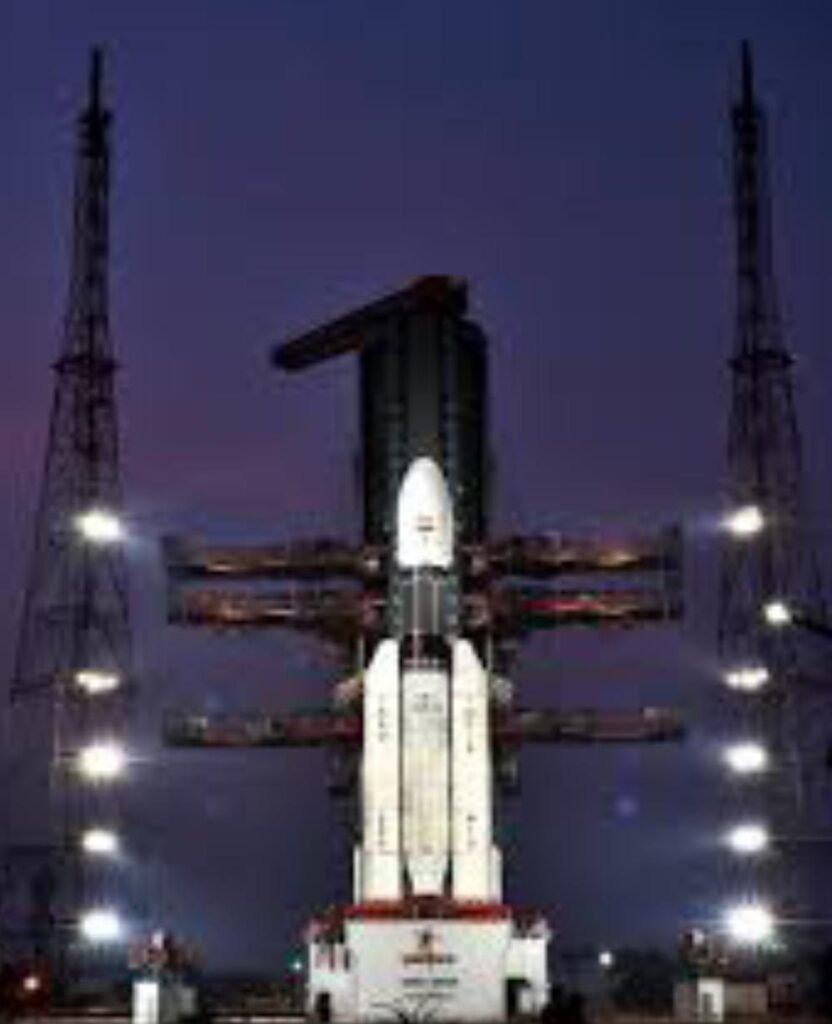
On 2 November 2025, at approximately 17 : 26 IST, the LVM3-M5 thundered off from the Second Launch Pad at Satish Dhawan Space Centre, Sriharikota, Andhra Pradesh. The mission carried CMS-03, an Indian-built satellite weighing in at about 4,410 kg — the heaviest communication satellite ever launched from Indian soil to geosynchronous transfer orbit (GTO). GKToday+1
The rocket stands around 43.5 metres tall and is characterised as India’s most powerful launcher so far, capable of placing up to roughly 8,000 kg into low-Earth orbit (LEO) according to ISRO’s published specifications. Space+1
Technical Breakthroughs & Indigenous Capability
What makes this mission significant is not just the payload size, but the maturity of the launcher. The LVM3 is a three-stage vehicle: with two large solid strap-on boosters in the first stage, a liquid core stage in the second, and a cryogenic upper stage in the third. GKToday+1
The upper stage, in particular, uses liquid hydrogen and liquid oxygen, which represents fully indigenous cryogenic technology developed by ISRO. With this success, India has demonstrated that it can launch heavy communication satellites without relying on foreign launchers. www.ndtv.com+1
According to ISRO Chairman V. Narayanan, the mission underscores India’s focus on “Atmanirbhar Bharat” (self-reliant India) in space technology. www.ndtv.com+1
Strategic and Practical Implications
CMS-03 will expand India’s communication capabilities over land and sea, which holds significance not only for civilian telecom services but also for maritime and strategic communication networks. AGN+1
From a strategic viewpoint, this launch signals that India no longer needs to resort to foreign launches for large satellites. Previously, even Indian satellites of ~4–5 tonnes often had to go aboard European rockets such as the Ariane-5. www.ndtv.com
Furthermore, the success of the LVM3 M5 is also a stepping-stone for India’s upcoming crewed spaceflight programme, Gaganyaan, which will rely on a “human-rated” version of the launcher. AGN+1
From Humble Beginnings to High Ambitions
The story of India’s space programme is one of steady and intentional climb. From the first sounding rocket launch in 1963 at Thumba in Kerala, to bicycle-carried nose-cones in early days, the journey has been marked by incremental but persistent growth. The Economic Times
Today, with LVM3-M5 and CMS-03, India has closed a capability gap in heavy-lift launches and signalled readiness for deeper and more independent space missions.
What Lies Ahead
With this capability firmly demonstrated, ISRO’s roadmap includes:
- A series of launches by March 2026, including further LVM3 flights and technology-demonstrators. AGN
- The Gaganyaan programme: uncrewed test flights followed by crewed missions (currently planned for 2027). The heavy-lift LVM3 is a key enabler. The Economic Times+1
- Larger ambitions: modules for a proposed Indian space station, lunar sample-return missions, Venus orbiters, and next-generation reusable launch vehicles are all on the table. The Economic Times
Significance for India and Globally
This launch matters for multiple reasons:
- Technological maturity: Demonstrating heavy-lift with indigenous systems elevates India’s status among nations capable of significant orbital insertions.
- Strategic autonomy: With this capability, India reduces dependence on foreign launch services for large satellites.
- Economic potential: A reliable heavy-lift service opens opportunities for commercial launches, international clients, satellite manufacturing growth, and a fuller ecosystem.
- Inspiration and national pride: These missions energise STEM-oriented aspirations in younger generations and reinforce India’s position as a rising space power.
Challenges Ahead
No achievement comes without new hurdles. Some of the challenges include:
- Ensuring consistent launch cadence (increase number of launches per year) to stay competitive and cost-effective.
- Developing and integrating next-generation launch vehicles (e.g., reusable or semi-cryogenic) to reduce cost per kg to orbit.
- Scaling up the space industry ecosystem, including private sector participation, supply-chains, launch infrastructure, and international collaborations.
- Operating heavier missions: for example, missions requiring 10 + tonne payloads to GTO, lunar sample returns, or deep-space probes, will demand new vehicles and missions.
Conclusion
With the successful flight of LVM3-M5 carrying CMS-03, ISRO has reached a definitive milestone in its heavy-lift launch capability. The mission is not just a technical triumph—it is a strong signal of India’s growing space-power status, strategic independence, and ambition for the decades ahead. As the agency turns to the next phases—human missions, space stations, large-scale commercial operations—it can launch from this point with both confidence and momentum.
Pingback: Humanity’s Greatest Wonder: The Space Station Orbiting 400 Kilometers Above Earth - Hindvaacha
Pingback: Runjhun Sharma: The Visionary Journalist Turned Media Leader Shaping India’s Newest News Narrative - Hindvaacha
Pingback: Nationwide Disruption as IndiGo Battles Massive Operational Crisis; Hundreds of Flights Cancelled Across India - Hindvaacha